Offline vs Online Trade Data: Which One Do You Need?
Introduction
Not all trade data is created — or delivered — the same way. When businesses start researching import-export intelligence, they quickly run into two terms that sound similar but mean very different things: offline trade data and online trade data. Choosing the wrong one can mean paying for information you can’t actually use, or missing the depth of data your sourcing team really needs.
This guide breaks down what separates the two, where each comes from, and how to figure out which one fits your business.
What Is Online Trade Data?
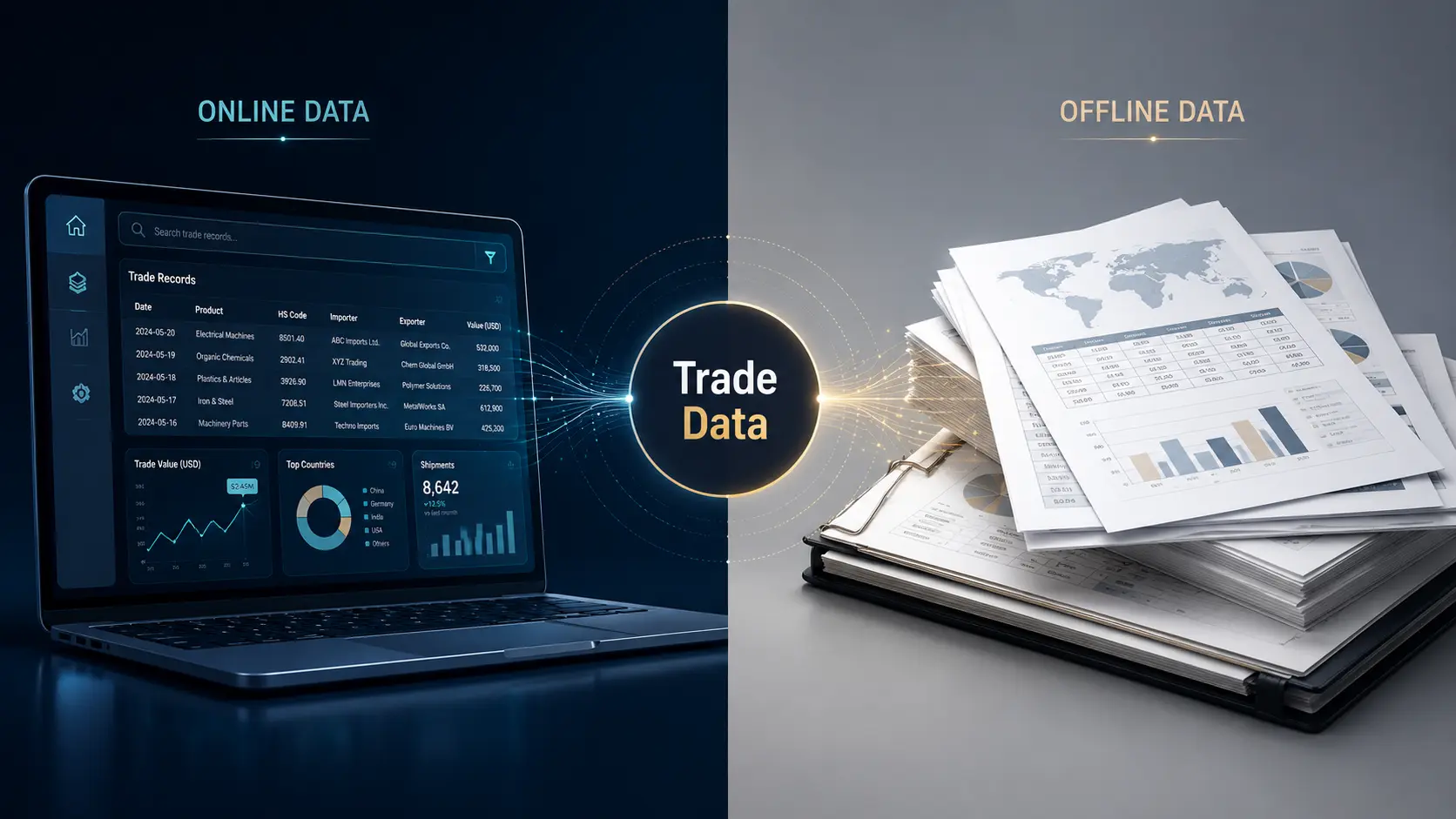
Online trade data refers to shipment records sourced from countries where customs authorities publicly disclose detailed transaction data — including the importer, exporter, product description, HS code, quantity, and shipment value. Because this data is disclosed at the source, it can be captured, structured, and made searchable through an online platform or API almost as soon as the shipment clears customs.
Countries like India, the United States (for certain categories), and several Latin American markets fall into this bucket. Businesses researching trade activity in these regions can typically access near-real-time, transaction-level detail — buyer names, supplier names, and full shipment history — directly through a searchable database.
What Is Offline Trade Data?
Offline trade data covers countries where customs records are not publicly disclosed in detail, or where government policy restricts access to buyer/supplier-level information. In these cases, aggregate trade statistics are usually still available — total import/export volumes by product category, country-to-country trade values, and broader trend data — but not the granular shipment-by-shipment detail you’d get with online data.
This doesn’t mean the data is unusable. It simply means the level of detail changes: instead of “Company A imported X tons of steel from Company B on this date,” offline data is more likely to tell you “Country X imported $Y million worth of steel from Country Z this quarter.”
Offline data is typically compiled from a mix of government trade statistics, industry reports, and licensed data-sharing agreements, then structured for research use — often with a longer processing timeline than online data.
Key Differences at a Glance
| Factor | Online Trade Data | Offline Trade Data |
| Level of detail | Transaction/shipment-level (buyer, supplier, HS code) | Aggregate/statistical (country, product category, volume) |
| Update frequency | Near real-time to weekly | Monthly, quarterly, or as government data is released |
| Source countries | Countries with public customs disclosure | Countries with restricted or limited disclosure |
| Best for | Lead generation, supplier vetting, competitor tracking | Market sizing, macro trend analysis, feasibility studies |
| Access method | Searchable database, dashboard, or API | Structured reports and data sets |
Which One Does Your Business Need?
Choose Online Trade Data If You Need To:
- Find specific buyers or suppliers to contact directly
- Verify a supplier’s shipping history before signing a contract
- Track a competitor’s shipment activity over time
- Build a lead list for sales or sourcing outreach
Choose Offline Trade Data If You Need To:
- Understand overall market size and demand for a product category in a country
- Study long-term trade trends between two countries
- Support a feasibility study or market-entry business case where company-level detail isn’t required
- Research a country where public customs disclosure is limited
When You Might Need Both
Many businesses end up using a blend of the two. For example, a company might use offline trade statistics to shortlist promising markets based on overall import demand, then switch to online, transaction-level data to identify the specific buyers or suppliers operating in that market. This combination gives both the macro view and the ground-level detail needed to act on it.
Coverage Matters More Than the Label
The bigger question isn’t just “offline or online” — it’s whether your data provider actually covers the countries you care about, and at what level of detail. A platform that consolidates both offline and online sources across 60+ countries spanning Asia, Africa, the Americas, and Europe makes it possible to get the right depth of data no matter where your market research takes you, without having to piece together information from multiple disconnected sources.
Final Thoughts
Offline and online trade data aren’t competing options — they’re two different tools suited to two different jobs. Online data gives you precision: real buyers, real suppliers, real shipment history. Offline data gives you scale: the broader market picture across a country or region. The right choice depends on whether your next move is a cold outreach email to a specific company, or a strategic decision about which market to enter next.